

The Final Goodbye: What Stranger Things taught me about the art of the ending
Spoilers alert! Some reflection on Stranger Things epic finale.

It is January 8th; the kids are back at school, and it finally feels as though we can hit the ground running.
I relaunched Zen and the Novel in the midst of the Christmas holidays, almost on a whim. I knew that if I waited for the “perfect moment” to restart, I would have likely never found it. I would have manufactured a million excuses to stay safe and shorebound, but instead, the leap is taken. I am now in the open water, swimming.
I had planned a different post for today, for what feels like the true beginning of the year, but I found myself obsessed by the Stranger Things series finale. I decided, in another “spur of the moment” shift, that this was a far more pressing topic.
Given the collective grief we are all navigating as this era ends, it felt timely to share some reflections.
First, I’d love to hear your perspective. What did you think of the finale? Please, share your thoughts in the comments.

I began watching Stranger Things while living in Hong Kong. At the time, my children were far too young to watch without being terrified. I was instantly fascinated by the 1980s setting and the poignant focus on the “coming-of-age” journey. Seeing my teenage idol, Winona Ryder, at the center of it all only fueled my obsession.
I’m not sure if the Duffer brothers initially envisioned the epic phenomenon the show would become, but the more I watched, the more I discovered storytelling elements that any writer could and should borrow. To me, the execution bordered on a masterpiece.
As I look back on five glorious seasons, a few elements stand out as vital lessons for any storyteller.
Character-Driven Stakes in a Plot-Driven World
Despite its massive commercial success and high-concept stakes, the show remained, at its heart, a character-driven tale. It is a coming-of-age story reminiscent of 80s classics like Stand By Me. The Duffer brothers have been transparent about these inspirations, and it shows: they understood that we don’t care about the monsters unless we care about the children running from them.
We see these characters evolve from preteens to teenagers on the threshold of adulthood. This physical growth creates a profound sense of familiarity, but the true brilliance lies in their internal narrative arcs. Each character serves as an example of a well-executed “Hero’s Journey.”
I am thinking of Will in particular. His journey, from a sweet, insecure boy grappling with his identity to a survivor who battles the monsters possessing him from within, is nothing short of extraordinary. Seeing him gather his power in the final season to contribute to the ultimate defeat of those forces was a powerful metaphor for the strength found in living fearlessly and authentically.
Metaphors!
The show is rich with metaphors, both subtle and overt. The monsters function as the looming shadow of adulthood threatening the purity of childhood. There is the crushing weight of expectation, and the classic friction of adults who “know best” versus the children who actually save the world.
Eleven, the “mage”, and the story’s central catalyst, functions as the personification of the “superpower” of childhood imagination. Yet, she is also a stark symbol of exploitation; to me she represents the innate wonder that adults so often seek to exploit and weaponize.
I am thinking of the reckless technological advancements of the last three decades, where societal experiments have been conducted at the expense of the young. Much like Eleven in a lab, a generation has been stripped of a “normal” childhood and catapulted into a new reality defined by isolation, screens, and the relentless hum of social media. “All I wanted was a normal childhood,” Dustin says at his graduation: a sentiment I suspect many children today would voice if they could rationalize the digital landscape they’ve inherited.
As the “party” matures, Eleven must inevitably be left behind. For her friends to transition into a reality where new adventures await, they must relinquish the extraordinary. These new challenges are less about literal monsters and more about the quiet, heavy burdens of adulthood: the loss of absolute certainty, the complexity of career, and the slow erosion of the “all-for-one” loyalty of youth. Eleven’s sacrifice doesn’t represent only the loss of a friend; with her, the “ party” is also surrendering the shield of magic that protected them from the banality of the real world.
The Power of the Full Circle
Many viewers complained about the ending, about a lack of spectacle or too “safe” writing. Personally, I am convinced that in a work of this scope, something has to give. It happens in novels, too; we rarely encounter a masterpiece that functions perfectly on both a plot and a line level.
While a TV series is often more forgiving of plot holes than a novel, a powerful ending can act as a bridge over those gaps. The heartbreak of the finale wasn’t found in a body count, but in the mourning of that lost sense of wonder. Even the plot holes and occasional narrative stumbles found their justification in a finale as poignant as it was consistent with everything that preceded it.
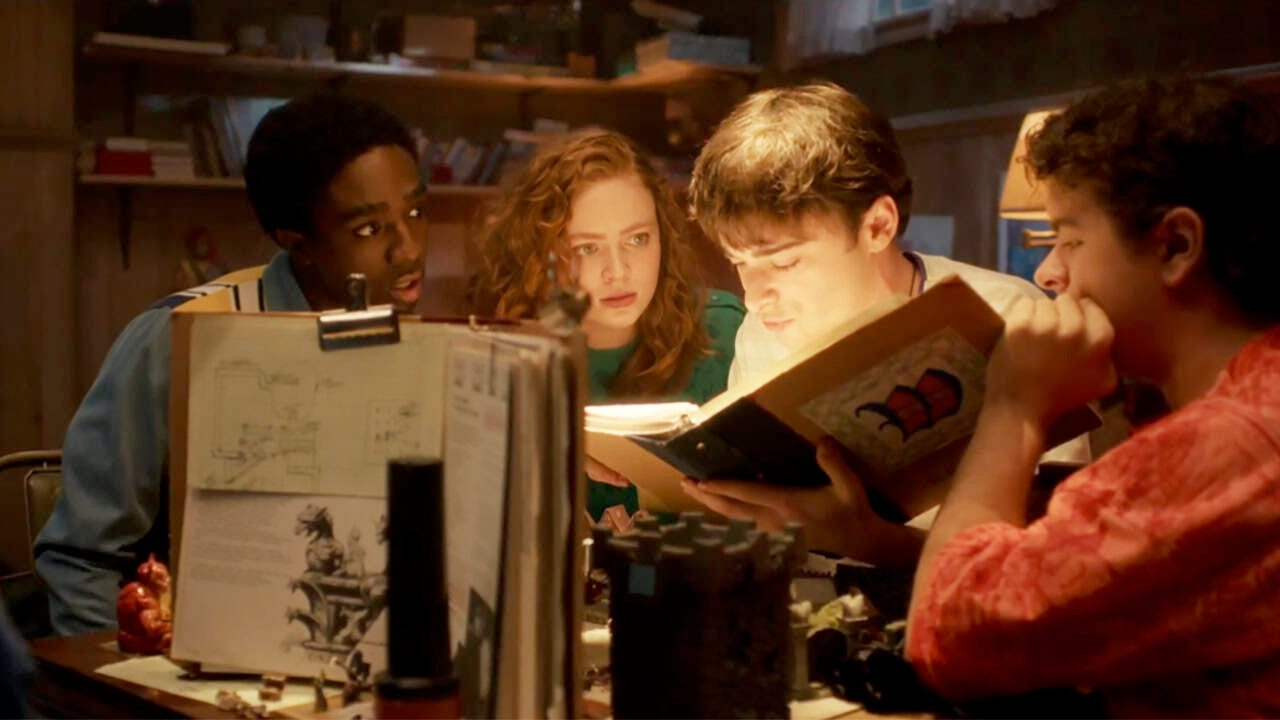
What I admired most was the creators’ commitment to the story’s soul. They stayed faithful to the core: this story was always about growing up. To see this come full circle in the final scene of the characters playing Dungeons & Dragons, a direct nod to the opening of season one, was to me the perfect ending. It was never truly about gore; it was about the catharsis of reaching the “other side” of adolescence and that’s what makes this series so beloved at least for me.
It didn't just deliver stunning special effects, it pulled at our heartstrings by showing us that the real extraordinary moments in life come from our relationships and the bonds we form.
The Beauty of the Loose Thread
The best stories are those that leave a few threads unexplored. I loved the nuances of this open-ended conclusion. Recently, I’ve read a few essays (sadly lost track of most of them but I linked the one I was able to recall) regarding the demarcation between “literary” and “upmarket” fiction, with the ending often being the defining line. I have never been a fan of “tidily packaged” resolutions because life is rarely so neat.
While the Stranger Things finale might appear “safe” at a glance, its real accomplishment lies in its ambiguity. By planting a tiny seed of doubt regarding Eleven’s ultimate fate, the Duffer brothers embraced the idea that a story can exist in more than one form. Had they offered a more certain, conventional ending, the conversation would already be over. Instead, they gave us a conclusion that lingers because it refuses to provide all the answers.

So, why did this story unite generations? For my children, I am guessing it rang true as a testament to friendship, adventure and the wonder of childhood. For me, it was a bittersweet mirror. I am currently watching my own children venture into their teenage years, leaving the “fantasy world” behind to embrace the realities of responsibility.
Stranger Things gave me the opportunity to re-enter that world and, more importantly, to do so alongside them. While my professional interest is rooted in understanding how successful storytelling functions, it was deeply rewarding to return to a place of total abandonment and trust in a story.
I hope you find a spark here to carry into your own writing projects. I, for my part, will be thinking about endings and what does it mean to close a door versus leaving it ajar. How can we find the most satisfying way for our stories to come full circle without too much intervention from our part and instead let the reader wonder for a little longer in the world we’ve built for them.
Well now I think you’re the new Pauline Kael. I absolutely love this analysis. I’ve already been thinking a lot about endings recently, in life and in stories, and this piece gives me even more ideas to add to the mix. I just sent your post to my daughter, who is the same age as the ST characters, and grew up with them on screen. The show consumed her from the first episode. She’s been obsessed. For the finale, even though I’ve been a spotty watcher of the show and my husband hasn’t seen a minute of it, we posted ourselves on either side of her on the couch, knowing she would be a wreck at the end. And she was. Absolutely inconsolable. She wept, she processed, she wept some more. Saying goodbye to those characters, she was also saying goodbye to her own childhood. There’s so much to unpack here, you’ve got me itching to go do a deep dive now on Stranger Things analyses.
I love the “loose thread” wording here. It’s so true that we unconsciously search for wrapped-up endings in life and story, but the most genuine expression is really the in-between. I appreciate reading this reflection today as I consider real-life events and my own writing. Thank you!