

Personal archeology
and the meaning of our things.

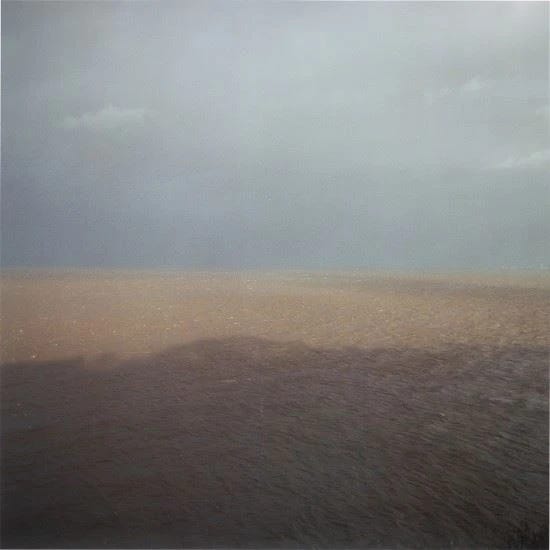
Gary Fabian Miller-Sections of England;The sea horizon, 1976-77
I followed the tragic news of the fires that devoured entire neighborhoods in Los Angeles with a great deal of anguish. California’s landscape is very similar to Portugal’s, and in Portugal, we, too, face recurrent fire threats due to periodical droughts and strong winds.
I couldn’t help but ask myself: what does it mean to suddenly lose your home? What does it mean to lose everything that links you to a place that, for you, is the definition of safety and warmth, a place that contains a lifetime of memories? What would happen if I lost every photo, every piece of art, every book in my home? Of course, these are just things. But it is also true that things are never just things; they are so much more than that.
A while ago, when I was about to move into our current home, I found a notebook where I had scribbled some thoughts about the process of moving. I wrote about sorting through belongings—deciding what to keep and what to let go of. In that process, I reflected on the meaning of things and objects that constitute our lifetime belongings.
Our personal items are our own archaeology.
Much like historical artifacts, the things that survive us will bear witness to our passage through this world and, often, will be the only testament that we once lived. Our belongings will tell future generations how people in this moment in time lived—the food they ate, the music they listened to, the technology of the era. While I wholeheartedly agree with the trend toward minimalism, reducing environmental impact, and fighting our hoarding and consumeristic tendencies, we must also acknowledge the emotional and intrinsic value of things.
One day, today’s stuff will be the archaeological remains of our time.
I have always attached enormous meaning to things. I’m the queen of mementos. For the longest time, I had a tendency to be a keeper. I still have a box somewhere in my parents’ attic (though I’m not sure it’s still there) containing remnants of my previous life—from my teenage years through my twenties. Diaries from my first trip to Beijing, letters exchanged with friends, concert tickets. While I’ve learned to be more discerning about what I keep, I like to surround myself with things that have meaning. I still have a memory drawer in my home (and in all the homes before this one) where pictures, notes, and children’s drawings are stored. It’s messy and not very organized, but from time to time, I love going through it.
Our experiences stay in our memories, but memory isn’t always reliable. The joy of rediscovering things we had forgotten about is still a delight.
Moving often had forced me to practice letting go. Over time, I’ve been forced to learn what is truly valuable and what can be left behind. I’ve become better at selecting, and I’ve learned the importance of leaving some empty space in our lives—not letting every corner of our homes be consumed by clutter or unnecessary possessions. Still, I acknowledge the importance of things as a collection of memories and as a personal testament to our time here. Our belongings define how we inhabit the world. They are signposts of our daily lives, and in some instances, they have the power to connect us to people who are no longer with us, making us feel their presence even when they’re no longer here.
When my father passed away almost four years ago, I couldn’t bear to move his things. I left his slippers by the bed, his books on the bedside table, and even the last medicines he took in the same corner of his dresser. I kept one of his jumpers and would, from time to time, go smell it until the scent of him faded. In those early days of grief, being surrounded by his things gave me comfort. It wasn’t until my last visit that I finally found the courage to part with his bathrobe and other personal items, cluttering a space that needed to breathe and make room for new life.
In a diary entry from Christmas 2021, the year my father passed away, I wrote:
“My heart is broken looking at your things that sit there unused. While I cry over objects that have no value other than having been part of our daily life, I get ready to leave. There was a time I cried because I was leaving you. Now, I cry because I leave your slippers behind. The pain of leaving is the same, and it renews itself every time.”
When we move or when someone dear passes away, we get to choose what we bring with us and what we leave behind. That process can be cathartic in many ways. However, I cannot imagine the pain of not having a say in what we keep and what we don’t. How does it feel to have our things—these intimate, personal artifacts—taken from us, to see them burned to the ground? Of course, things can never compare to the value of life itself. Surviving such a disaster is a blessing, but things are expressions of our lives, our aspirations, and our accomplishments. We have the right to mourn them, and what they represent to us. We also have the right to mourn a home that is no longer there.
A home is not just a physical space but a reflection of who we are—a place where memories are woven into the very walls and objects that fill it. To lose a home, whether through disaster or change, is to lose more than just a building. It’s to lose the essence of what made that space ours—the moments, the personal touches, the sense of comfort and safety. I can only imagine the pain of experiencing such a loss. The best and I guess the only way to cope with it is to anchor ourselves in the memories we’ve created, using them as the foundation on which we can rebuild.
I saw heartbreaking photos of people finding remnants of their burned homes—little objects perhaps once overlooked that, in that context, acquire an inestimable value. I like to think that these fragments while being the only tangible link to the life that was, will also serve as the bridge to a new life ahead—ready to be rebuilt, one memory at a time.