

Just play
on choosing process over results.

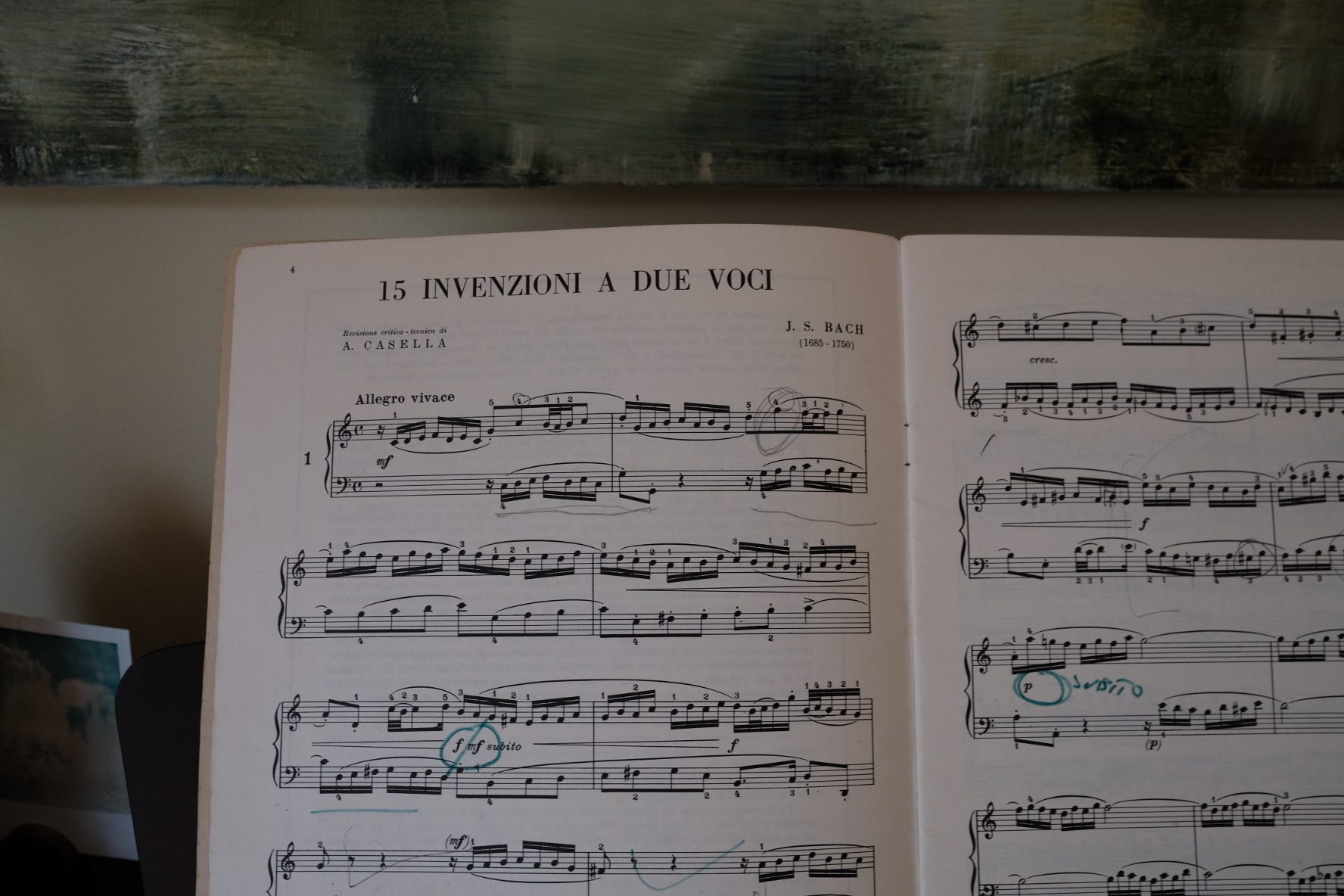
I took out some old sheets of music from a very old suitcase the other day, out of the blue, just because I felt like it. The time somehow was right. After what? Almost thirty years? I tried again a couple of years ago, I bought a piano second hand, an electric one, not ideal for my perfectionist aspirations, but it works well and it’s all that matters, I decided. I had suddenly felt the urge to start playing again, something I hadn’t done in years. After I quit playing, at the age of seventeen, I never touched a piano again.
I was frustrated at first because I couldn’t read the music fluently, it took me a while to get back into it. I am not a natural, I thought, this piano is wasted on me. “If you loved the piano you would practice more”, my mother’s words echoed in my mind. I am not good enough, was the refrain I kept telling myself in those days, long gone now, when I handed my withdrawal letter from the Conservatorio, on a teary, snowy day.
Being a musician was one of my father’s secret dreams, and he tried to see if any of us had caught the bug of music. He tried with my siblings with no success. They were very honest from the beginning and quit after a few lessons. Then it came to me. I loved music from an early age, but I wasn’t the musical genius I hoped I’d be. I was however an ambitious child with perfectionist tendencies, I took everything to my own heart. I quickly I realized that practising piano was a tedious affair especially with a teacher who didn’t put much effort in making it fun. My parents chose her because she was a great pianist, but now I know she wasn’t a great teacher. Extremely technical and strict, she was expecting hours of practice from a ten-year-old and I hated the practice but never had the courage to confess, not for nine years. I was stubborn, and most of all I wanted to make my father happy. So I tried and tried, lesson after lesson, braving the anxiety that got hold of me every time he had to drive me to a nearby town for my lessons that more often than not, at least in the beginning, would end up in the teacher shouting at me for not practising enough. In those years a seed was planted, I believe. In order to succeed you have to struggle. The more the struggle the greater the success.
I didn’t like it and therefore I rebelled against it.
The other day I started to obsessively play an old piece, one I learned for the admission exam to the Conservatorio. Kuhlau sonatina, op.55 n.1. I already had another teacher by then, the only one who tried to persuade me to not quit the piano because I was good at it, because I could continue. She injected me with so much confidence that for a while I thought I could really do it. I could get the diploma my parents so much wanted me to get. She taught me to to play for the joy of it, to enjoy the practice because it was rewarding in itself. I did well at the exam and got into the school, I was fourteen years old by then and my time there only lasted three years. Once in music school, I had to change teacher once again and she wasn’t as invested in me as my second one.
Or perhaps a time comes when it’s hard to sustain a dream if it’s not yours.
I am finally able to play the piece as I wanted to, with no dirty sound, no unnecessary pauses. It’s not flawless but it’s well played and after a twenty-five years’ break I consider this a win. When I feel the need to calm down, I go to the piano and just lose myself in the music. And while doing that I realized that this is the gift I was given and here lies the biggest misunderstanding. I thought I was learning to play the piano because it was expected of me to become a pianist and fulfill my Dad’s dream of concerts, applause, stage lighs. I was crushed under the weight of the expectations and my first teacher’s harsh words. I never got over the disappointment I felt I gave my parents even if this was perhaps just my perception. It never occurred to me that I was playing for the music because the music is able to enrich us, humans, in a way that probably nothing else can. The gift was playing, not what I would become through playing. Besides, practicing the piano can teach you so much more beyond the music. It is a lesson in perseverance, a steady rotation of failing and success that very much mirrors life, and that you have to learn to accept with humbleness.
I am reading Annie Lamott’s “Bird by bird” and in one passage she writes about the students in her creative writing classes who “they kind of want to write, but they really want to be published.”
The book is full of wonderful insights for writers and just generally for life but this particular passage made me pause and think. How many times in my life, rather than focusing on the process did I focus on the outcome? We live in a society that glorifies goals as such, outcomes, achievements. And what happens if we don’t achieve?
After I quit the piano I blamed myself for wasting my parents’ money, for wasting my time, but even more dangerously so, I started seeing myself as not good enough. I started to see myself as lacking that kind of mysterious, magical quality that is necessary to succeed which I wrongly thought was talent but really often is just perseverance. But let me tell you, persevering while being miserable, is not an easy task.
What would have happened if my first piano teacher instead of focusing on how well I did my scales had taught me that piano can be fun and rewarding, not just difficult, repetitive, and boring? What if she had found creative ways for me to enjoy the process of learning? What if she had encouraged me instead of only highlighting my faults? Would have I been better? Would have I continued playing?
When I started dreaming of writing stories, which happened at around age fifteen, my enthusiasm was inevitably crushed under the pressure of my imaginary failures. What if I didn’t achieve? What if I never published a book? How could I even face myself? At seventeen I wrote a short novel which I sent to a magazine competition. I did not win so this reinforced my idea that probably, after all, I wasn’t good enough. It never occurred to me that what I should have focused on was the fun, the discovery, the insights, that writing those pages brought to me.
Winning or not was irrelevant, and I wish somebody had told me that chasing external approval is the killer of any creative endeavor.
By insisting on dividing the world between winners and losers, overachievers and underachievers, how much talent are we actually missing out on? How many artists never get out of their fear-built caves, how many untold stories?
I have started enjoying the process of practicing the piano again. I see every new section as a challenge that is fun to tackle. I let go of the expectation of being able to sit and play effortlessly without learning involved, but at the same time, I don’t let a more complicated passage discourage me. I start slow, very slow. And I repeat again, and again until the music flows. It might take hours, or days and it certainly takes patience, it takes humbleness to be a beginner again, but the real reward, now I know, is in the learning. My failure (or what I considered such) with the piano has shaped so much of my teenage years which is why I believe it is so important to change my approach with my kids. I want to do my best first of all to encourage what their true passions and interests are. I want them to be in charge of their own life discoveries without putting any unnecessary pressure on them. To teach them to accept and welcome their life as it is, not as I think it should be. We often project our hopes and fears onto our children, seeing their success or setbacks as an extension of ourselves. Their success is our success their failures our failures, but, as hard as it is to accept at times, children are independent people from us, in charge of their own present and future just as we are. All I can do is model for them the joys of learning new things and offer support when and if they need me.
Of course, I am not suggesting that I will encourage them to live aimless life. I know very well the joys of achieving a goal, but it’s important not to let our lives revolve around it. The joy of achieving is ephemeral and sometimes lasts the space of a day, it’s the process that contains the most valuable lessons I believe. And I want them to know that there is joy in learning, there is a pleasure to be found in the process, that we shouldn’t let the weight of our goals crush us before we even try. Just because we love doing something it doesn’t make it less valuable, on the contrary, the best way to honor our life is to inject it with joy, excitement, fulfillment. This old romantic and slightly terrifying myth of having to struggle in order to find success might not be always true. I want to teach them to take life with easiness and playfulness.
In other words, I want them to learn to play for the sake of playing.
If they focus on the process, not the outcome, if they learn to love what they do, most probably the outcome will follow and if it doesn’t, well, at least they weren’t miserable while trying.
I am onto the next piece now. I chose a slightly more challenging one. As it often happens, I thought I should perhaps ask for help. I thought I needed lessons again, somebody to guide me but then I said to myself that no, at this point I don’t need lessons for a journey that has no destination other than just my own pleasure.
There are times to seek teachers and times to be our own teachers.
For now, I have everything I need in me to just sit at the piano and play.