

Conversations with Creatives: Living a global writing life with Mariam Navaid Ottimofiore
Why home is a story we carry, not a place we leave.

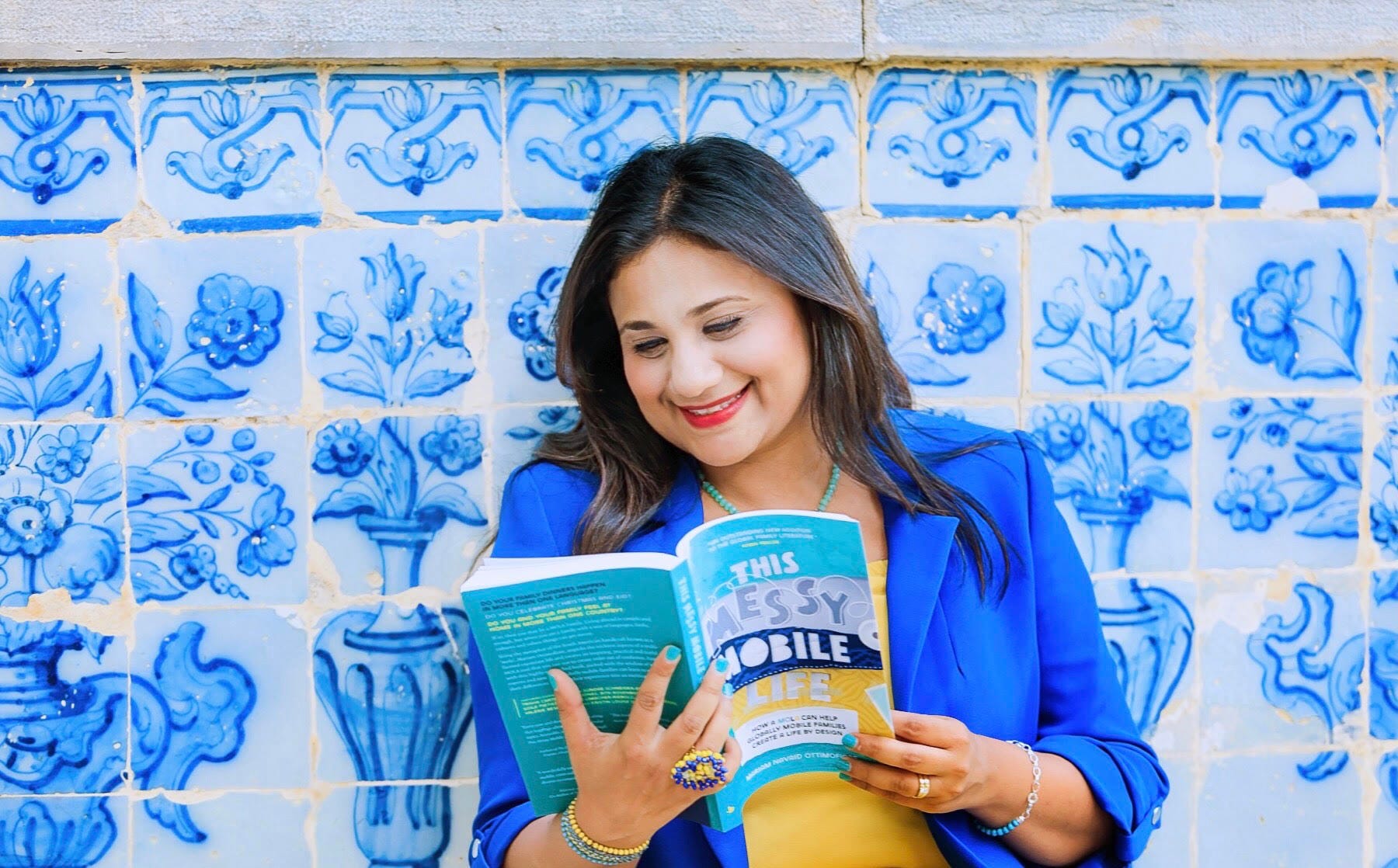
I have been fortunate enough to come in contact with so many smart, kind, and talented women over the years, some of whom I am lucky enough to call friends. There is a particular kind of energy amongst women who are pursuing their goals with dedication and care that is uplifting and contagious. This is part of the reason why I thought of starting this monthly column: to highlight the creative people who are inspiring me on Substack and beyond.
Today it is the turn of Mariam Navaid Ottimofiore, a writer, speaker, and genuinely inspirational powerhouse. I first met Mariam through our children’s school and then got to know her better when I joined the women’s writing group we are both part of. Having lived between countries for more than twenty years now, I find her words and experience deeply resonant. It is a pleasure to have her here and ask her some questions about her “big messy mobile life.” I hope you find it just as inspiring.
1. Mariam, thank you so much for sitting down with us. To kick things off, could you tell us a little about yourself in a few sentences. Given how rich your background is I know it’s easier said than done!
Thank you for having me! I am a writer, researcher, speaker and economist and every few years, I change countries, cultures, languages and communities, and as a result, my sense of identity, home and belonging is ever developing on the move. Perhaps my most consistent identity is that of a storyteller and it is the reason why my writing focuses on moving, migration, living abroad and the effects of place and displacement in shaping our stories. I am an expert in butchering every new language I learn, I am perpetually lost in every new place I call home, I can never remember my phone number or my address and making my morning cup of coffee requires an international adapter or two.
2.You are something of a quintessential global citizen: born in Pakistan, raised in the States, and having spent much of your life abroad. How have all these experiences shaped your writing, and are there common themes that run through your work as a result?
That’s right, I was born in Pakistan and raised in the Kingdom of Bahrain, the United States and Pakistan in my childhood. Growing up as a Third Culture Kid amongst different cultures and languages set the pace for my later adult life where I continued moving to the UK, Germany, Denmark, Singapore, UAE, Ghana and Portugal. I have also adopted Italian citizenship through marriage. The one thing that has remained constant after living in ten countries, thirteen cities and four continents, is my love for writing. I write to process my global adventures and I am passionate about bringing cross-cultural stories and multicultural identities to the page. My books center on global living and are for anyone who has ever been brave enough to move to a new country and exchange a life in the familiar for a life in the unfamiliar.
If you’re enjoying this Conversation with Mariam, please let us know by leaving a comment!
3. If you had to distill everything you’ve lived and learned into a single sentence , your life philosophy, what would it be?
“Home is a story that comes with you; it’s not a place you leave behind.”
My life philosophy, if distilled into a single sentence, would probably be: “Home is a story that comes with you; it’s not a place you leave behind.” Home is no longer a physical place for global nomads like myself, it is a story that we take with us to every new place we move to. It has provided a lot of comfort and continuity in a life marked by constant change and transition.
4. When did you first know you wanted to be a writer, and what was it that drew you to the craft?
“What drew me to learning the craft was the complexity which mirrored my own globally mobile life. I enjoyed peeling back the layers of storytelling.”
I grew up devouring books and reading way past my bedtime. I always wanted to be a writer, but at college in the US and university in the UK, I studied Economics and Political Science. I still kept up my writing, although initially in my corporate career I was doing more business writing. Then an international move from Denmark to Singapore in 2011 while being five months pregnant with my first child prompted a reawakening and served as a catalyst to fully embrace the writer in me. I switched to travel writing; writing for magazines like Expat Living Singapore and Expat Living Hong Kong and then became a Content Editor for a lifestyle magazine based in Singapore. But it wasn’t until another international move from Singapore to Dubai in 2014 while being four months pregnant with my second child, which finally gave me the courage to set up my own blog and freelance writing services which focused on the topics I really cared about; globally mobile families, moving over and over again and starting afresh, raising Third Culture Kids (TCKs) and a multicultural, multilingual and multi-mobile family across borders. Learning the craft came much later through writing residency programs, global conferences and international writing opportunities. What drew me to learning the craft was the complexity which mirrored my own globally mobile life. I enjoyed peeling back the layers of storytelling.
5. You’ve now written two very different books; a non-fiction work and a novel. How does your creative process differ between the two, and what does your writing routine actually look like day to day?
“I had figured out I was a plotter, not a panster but I would often get really stuck and lost in the story I was trying to tell. I plotted my entire novel on colorful post-its on a cork board.”
My first book This Messy Mobile Life was non-fiction and I found it a lot easier to write, perhaps because it allowed me to lean into my academic background as a researcher and economist. My creative process was rather structured and I was kept on track by my writing mentor who reviewed and edited each chapter. In contrast, my creative process for my second book, my debut novel The Guilty Can’t Say Goodbye was all over the place! I worked on it by myself and didn’t even show it to my writing mentor until I had a shitty first draft which was about a year and a half in. I had figured out I was a plotter, not a panster but I would often get really stuck and lost in the story I was trying to tell. I plotted my entire novel on colorful post-its on a cork board. I decided to brush up on the craft and took various courses on character development, pacing, dialogue and more offered by other writers. I also joined writing communities such as Women Fiction Writers to hone in my creative process.
My writing routine varies but I typically write three days in a week. I keep one day for catching up on all the admin, emails, book promotions, international book tours that come with being an author and I keep one day (usually Friday) to take myself out on an artist date as encouraged by Julia Cameron, in The Artist’s Way. I find that part of being a writer is allowing myself time to sit, observe, people watch and making time for this is an equally important part of my writing routine. This is usually when new ideas or inspiration will emerge.
6. What is your biggest piece of advice for writers who have a story to tell but struggle to start or to finish? Where does the block usually live, and how do you push through it?
“Start before you feel ready. Give yourself permission to fail, to stumble, to pick yourself up, to muddle your way through. There will never be a perfect time in your life to write a book”
I’ve been there. Struggling to start and to finish. My biggest piece of advice to writers would be A) set yourself up for success in how you manage your day. Be rather protective of your writing time, carve that out in your calendar and say no to everything else and other demands on your time. B) Start before you feel ready. Give yourself permission to fail, to stumble, to pick yourself up, to muddle your way through. There will never be a perfect time in your life to write a book. So just start now. Embrace the growth and the journey. Celebrate each milestone. Try to really enjoy the writing process and all the ups and downs that come with it, instead of focusing on the end result which is the book. C) Writers block is real. If you get stuck, my advice is don’t try to push through. Sit in your discomfort. Try to analyze where or why that block is coming from. Sometimes, we may need outside help, a fresh pair of eyes, a writing mentor or support from a writers group. Sometimes it might need internal focus. I encourage going for a daily walk. It helps to sort out ideas in your head, and perhaps fix some plot holes too. Most importantly, don’t give up.
7. How has your globally mobile life affected your writing practice, has the constant movement been a source of inspiration, or has it ever gotten in the way?
“I was grateful to be living a messy mobile life while writing about it too. Sometimes art imitates life and sometimes life imitates art!”
This is a great question. If I’m being brutally honest, I think it has been both; a hindrance and a help. For example, when I was living in Dubai and in the middle of writing my first book This Messy Mobile Life in 2018, I was on a strict writing and publishing deadline of Spring 2019. Then we found out that we are going to face another corporate relocation, this time from the UAE to Ghana in the summer of 2018. Initially, the move disrupted my flow and rhythm of writing the book and also my focus too. My focus became on managing this international move for my family and initially it took my focus away from writing. Even after the move, I was responsible for settling our family into this new corner of West Africa and I found it so hard. It was my husband who reminded me “Aren’t you writing about living this messy mobile life around the world?” And that’s when I realized I had to change my mindset and look at this move not as a disruption but as a source of inspiration instead. I started writing about our move to Ghana in the book and those chapters were incredibly raw because I was going through all the emotions of transition, culture shock and homesickness in real time and writing about it at the same time. In hindsight it made the book stronger, more honest and real and I was grateful to be living a messy mobile life while writing about it too. Sometimes art imitates life and sometimes life imitates art!
8. Finally, what’s next for you? Is there a new project in the works you can share with us?
I’m excited to share that I’m working on several different projects. One is a short story collection focused on themes of place and displacement. The other is a novel where multicultural food and cooking provide a culinary look at how we express our identity through flavors on a plate.
Thank you so much for being here with us and please let us know where can we find you and learn more about your work. (IG, website, others)
You can visit my author website or find me on social media below:
Website: www.mariamnavaidottimofiore.com
Instagram: https://www.instagram.com/mariam.navaid.ottimofiore/
Facebook: https://www.facebook.com/authorpagemariamnavaidottimofiore/
Goodreads: https://www.goodreads.com/user/show/104772670-mariam-ottimofiore
Amazon: https://www.amazon.es/Guilty-Cant-Say-Goodbye-secrets/dp/1915548187
LinkedIn: https://www.linkedin.com/in/mariamottimofiore/